A few years ago, you asked Google a question and clicked a blue link. Today, many people ask ChatGPT, Gemini, Perplexity, or Google’s AI Overviews and get a complete answer without visiting a single website. Often that answer names specific businesses, quotes specific pages, and recommends specific brands.
So what if your business is never named?
You type “best SEO company in Ahmedabad” or “how to choose a Google Ads agency” into an AI tool. Your competitors appear. You do not. Your website is live, your content exists, and you may even rank on Google, yet AI answers act as if you do not exist.
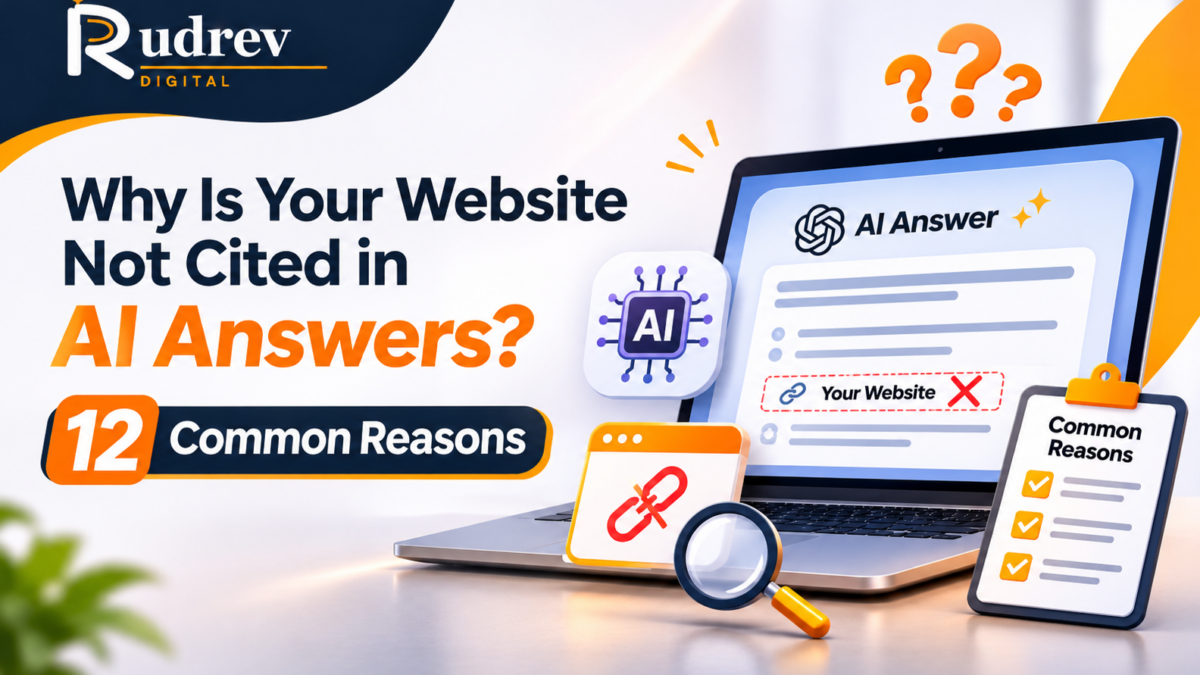
If your website is not showing in AI search results, you are not alone. This is now one of the most common questions business owners ask. The good news is that the causes are usually clear and fixable. This guide covers the 12 most common reasons AI tools do not cite your website, in plain language, with practical fixes for each.
Quick Answer: Why Is My Website Not Showing in AI Answers?
The most common reasons your website is not cited in AI responses are:
- AI crawlers or search engines cannot access your pages.
- Your content does not give clear, direct answers.
- Your brand is not recognised as a trusted entity.
- You lack structured data and clear page structure.
- Few other websites mention or link to you.
- Your content is thin, generic, or outdated.
- Competitors cover the topic more thoroughly.
To find your specific cause, test your brand in several AI tools, then run a full SEO audit that includes AI visibility.
How Do AI Tools Decide What to Cite?
Before fixing the problem, it helps to understand how AI answers work. Tools like ChatGPT search, Perplexity, Gemini, and Google AI Overviews generally pull from a mix of sources:
- Web pages they can crawl and retrieve in real time
- Information learned from large amounts of training data
- Trusted, well-known entities and brands
- Content that is clear, structured, and easy to quote
Each system works differently, and none publishes a complete rulebook, so anyone promising a guaranteed formula is guessing. But the patterns are consistent: AI tools prefer sources that are accessible, clear, credible, and widely referenced. If you are weak in any of those areas, you are easier to skip.
This is why Answer Engine Optimization (AEO), sometimes called Generative Engine Optimization (GEO), has become part of modern SEO. Traditional SEO still matters, because many AI tools rely on search results, but it is no longer the whole picture.
First, Check: Does AI Know Your Brand?
Start with a simple test. Open ChatGPT, Gemini, Perplexity, and Google, and try prompts like:
- “What is [your brand name]?”
- “Best [your service] company in [your city]”
- “How to choose a [your service] provider”
- “Alternatives to [competitor name]”
Note whether your brand is mentioned, whether the information is accurate, and which sources are cited. Repeat the test a few times, since AI answers can change between sessions. This gives you a baseline and shows exactly who is winning the citations you want.
12 Common Reasons Your Website Is Not Cited in AI Answers
1. AI Crawlers and Search Engines Cannot Access Your Site
If a system cannot reach your content, it cannot cite it. Common blockers include:
- A robots.txt file that blocks AI or search crawlers
- Security tools or firewalls that block bots
- Pages hidden behind logins, pop-ups, or forms
- “Noindex” tags left from development
- Heavy JavaScript that hides content from crawlers
Different AI tools use different crawlers, such as OAI-SearchBot for ChatGPT search or PerplexityBot for Perplexity. Blocking them can reduce your chance of appearing in those answers.
How to fix it: Review your robots.txt and security settings. Decide deliberately which bots to allow, make sure key content is visible in plain HTML, and confirm that Google can index your pages, since Google AI features rely on Google’s index. A technical SEO review can catch hidden blockers quickly.
2. Your Content Does Not Answer Questions Directly
AI tools look for passages that answer a question cleanly. Many business websites bury the answer under long introductions, marketing language, and vague claims.
For example, if someone asks “how long does SEO take?” and your page opens with three paragraphs about your company’s passion, an AI tool will find a clearer answer elsewhere.
How to fix it: Put a short, direct answer right under each question-style heading, ideally in the first one or two sentences. Then expand with detail. Think of it as giving the “quotable” answer first and the explanation second.
3. Your Brand Is Not Recognised as an Entity
AI systems think in terms of entities: people, brands, places, and topics, and how they relate to each other. If your business is not clearly defined across the web, AI has little confidence about who you are or what you do.
Signs of a weak entity include:
- Inconsistent business name, address, or description across websites
- No clear “About” page
- Missing or empty profiles on major platforms
- No connection between your brand and your topic
How to fix it: Make your name, services, location, and description consistent everywhere. Build a strong about page, complete your Google Business Profile, and maintain accurate profiles on LinkedIn and relevant directories. For local brands, Google Business Profile optimisation strengthens both map visibility and entity clarity.
4. Missing or Weak Structured Data
Structured data, or schema markup, labels your content so machines understand it: this is an organisation, this is a service, this is an FAQ, this is a review.
Without it, systems must guess. With it, your content becomes easier to interpret and extract.
How to fix it: Add relevant schema such as Organization, LocalBusiness, Service, FAQPage, Article, and Breadcrumb. Validate it with testing tools, and make sure the markup matches what is actually visible on the page. Schema supports understanding, but it is not a magic switch.
5. Poor Page Structure and Formatting
AI systems extract information in pieces, so unstructured walls of text are hard to use. Pages that rank well in AI answers usually have:
- A clear H1 and logical H2 and H3 headings
- Question-based headings
- Short paragraphs
- Bullet points and numbered steps
- Tables for comparisons
- Defined terms and plain language
How to fix it: Restructure important pages so every section answers one clear question. Make each section understandable on its own, because AI may quote just that piece.
6. Few Brand Mentions Across the Web
AI tools tend to trust brands that other credible sources talk about. If your website is the only place that says you are good, your claim carries less weight.
Mentions can include:
- Industry websites and publications
- Directories and review platforms
- Podcasts, webinars, and interviews
- Customer reviews
- Partner and client websites
- Discussions on professional communities
How to fix it: Build genuine presence beyond your website. Earn reviews, contribute expert comments, publish useful resources others reference, and take part in your industry community. Quality mentions matter more than quantity.
7. Weak Backlink and Authority Signals
Backlinks remain a strong signal of trust, and many AI search tools draw on pages that already perform well in traditional search. A site with few quality links is less likely to be retrieved at all.
How to fix it: Earn links through useful content, local citations, partnerships, case studies, and digital PR. Avoid bulk link packages, which can damage trust. Strong foundations in SEO services support AI visibility too.
8. Thin, Generic, or Copied Content
If your content says the same thing as hundreds of other pages, AI has no reason to choose yours. Generic advice, rewritten competitor articles, and mass-produced AI-written content rarely stand out.
How to fix it: Add what others lack: original examples, real numbers from your work, practical steps, clear opinions, and customer scenarios. Content with real experience behind it is far more citable than content that simply repeats common knowledge.
9. No Visible Experience, Expertise, and Trust (E-E-A-T)
AI tools aim to give reliable answers, so they lean toward sources that appear credible. This is especially true for sensitive topics like health, finance, and legal matters.
Trust signals include:
- Named authors with real credentials
- Clear company details and contact information
- Case studies and client results
- Reviews and testimonials
- Accurate, up-to-date information
- Transparent policies
How to fix it: Show who is behind your content and why they are qualified. Publish real case studies, add author bios, and keep information current. This matters most in industries like healthcare, where accuracy is critical.
10. Outdated Content
AI tools that search the web often favour recent, accurate information. A page that still describes 2022 tactics, old pricing, or retired features can lose out to fresher sources.
How to fix it: Review your key pages regularly, update statistics and examples, and show a clear “last updated” date. Refresh your best pages rather than only publishing new ones.
11. You Are Not Covering the Whole Topic
AI tends to cite sources that cover a subject thoroughly. If you have one shallow page on a topic and a competitor has a complete cluster covering definitions, how-to guides, costs, comparisons, mistakes, and FAQs, they look like the expert.
This idea is called topical authority.
How to fix it: Build content clusters around your core services. For example, around SEO you might cover audits, technical SEO, local SEO, pricing, and industry-specific guidance, with each page linking to the others. Rudrev’s service pages for local SEO, B2B SEO, and SaaS SEO show how specialised pages support a larger topic.
12. Your Content Does Not Match Real Conversational Questions
People talk to AI tools in full sentences: “Which digital marketing agency in Ahmedabad is good for a small manufacturing company?” If your pages only target short, formal keywords, you may miss these longer, natural queries.
How to fix it: Research the real questions your customers ask, from sales calls, emails, reviews, and “People also ask” boxes. Create pages and FAQs that answer them in plain language, including your location, industry, and situation where relevant.
Bonus Reasons AI May Be Skipping You
- Your site is slow or unreliable. Pages that time out may not be retrieved. Regular website maintenance keeps performance steady.
- Your content is locked in PDFs, images, or videos without text. Provide text versions and transcripts.
- Inconsistent information. If your pricing, services, or location differ across pages and platforms, confidence drops.
- Weak local signals. For location-based queries, missing reviews and citations reduce visibility.
- A poorly structured website. Messy navigation and weak internal linking make it harder to understand your topics. A website redesign can fix the foundation.
Real-Life Example: A Business AI Never Mentioned
Imagine a B2B company that sells industrial equipment. It has a decent website and ranks for a few keywords. But when buyers ask AI tools “who are reliable industrial equipment suppliers in Gujarat?”, competitors are named and this company is not.
When the team investigates, they find:
- The robots.txt file blocks several crawlers by default.
- Product pages are mostly specifications with no explanation or FAQs.
- There is no schema, and the company’s name appears in three different formats online.
- The company has almost no third-party mentions or reviews.
- Competitors have guides answering buyer questions that this company never covered.
After fixing access, adding clear answer-first content, applying schema, cleaning up business information, collecting reviews, and building a few quality mentions, the company becomes far easier for both search engines and AI tools to understand and trust.
The lesson: AI invisibility is rarely random. It is usually a stack of accessible, clear, and credible signals that are missing.
A Simple Checklist to Improve Your AI Visibility
Use this step-by-step process.
- Test your brand in ChatGPT, Gemini, Perplexity, and Google. Record what appears.
- Check crawl access. Review robots.txt, firewalls, and indexing.
- Confirm Google indexing in Google Search Console.
- Rewrite key pages with answer-first sections and clear headings.
- Add FAQs based on real customer questions.
- Implement schema markup for your organisation, services, and FAQs.
- Standardise your business information across all platforms.
- Collect reviews and build credible mentions.
- Strengthen authority through quality backlinks and expert content.
- Refresh content and track your AI mentions monthly.
If this feels like a lot, a professional audit can prioritise what matters first.
How Long Does It Take to Appear in AI Answers?
There is no fixed timeline, and no one can honestly guarantee a citation. As a general guide:
- Access and technical fixes: can take effect within weeks, once pages are recrawled.
- Content and structure improvements: often take 2 to 3 months to show an impact.
- Brand mentions and authority: build gradually over 4 to 6 months or more.
AI answers also change frequently, so the goal is steady improvement, not a one-time fix. While you build organic visibility, paid campaigns can keep enquiries flowing. Rudrev’s Google Ads management and lead generation services work well alongside SEO and AEO.
SEO vs AEO: Do You Still Need Traditional SEO?
Yes. AEO does not replace SEO, it builds on it.
- SEO helps search engines find, understand, and rank your pages.
- AEO helps your content be selected, quoted, and trusted inside AI-generated answers.
Many AI search tools draw from pages that are already indexed and well regarded. That means the basics, such as crawlability, quality content, speed, authority, and trust, still matter. The businesses that win in 2026 are those that do both well.
When Should You Hire an AI SEO Specialist?
You can fix some of these issues yourself. Consider expert help if:
- Your competitors are cited and you are not, despite good content.
- You are unsure whether AI crawlers can access your site.
- You lack the time or tools to audit properly.
- Your website structure or technical setup needs deeper changes.
- You are in a competitive market and need leads, not just visibility.
- You want SEO and AEO planned together.
Whether you are a local business, a B2B company, or a software brand, the right partner starts with a diagnosis, not guesses. You can compare options in our SEO packages, or if you are in Gujarat, explore our SEO services in Ahmedabad.
How Rudrev Digital Helps You Get Found by Search and AI
Rudrev Digital helps businesses become visible where customers actually look, in search results and AI answers. Our approach includes:
- Full SEO and AI visibility audit: crawl access, indexing, content, structure, schema, and authority.
- Answer-first content strategy: pages built around real customer questions.
- Technical and on-page optimisation: clean foundations for search engines and AI tools.
- Entity and trust building: consistent brand information, reviews, and proof.
- Website development support: from WordPress development to full redesign.
- Lead-focused reporting: tracking enquiries, not vanity metrics.
Explore all our services or learn more about Rudrev.
Frequently Asked Questions (FAQs)
Why is my website not showing in ChatGPT, Gemini, or Perplexity?
The most common reasons are blocked or inaccessible pages, content that does not answer questions directly, weak brand recognition, missing structured data, and few trusted mentions elsewhere online. Test your brand in each tool and audit your site’s crawl access and content structure.
How do I get my website cited by AI?
Make your pages accessible to crawlers, write clear answer-first content, use structured data, keep information accurate and current, and build credible mentions and reviews across the web. No method guarantees a citation, but these steps improve your chances.
How do I appear in Google AI Overviews?
Google AI Overviews draw from pages Google can index and understand. Focus on strong SEO foundations, helpful content that directly answers questions, clear structure, schema markup, and trust signals. There is no special submission process.
Does traditional SEO help with AI search visibility?
Yes. Many AI tools rely on indexed, authoritative web pages, so crawlability, quality content, backlinks, and site health still matter. AEO adds clear answers, entity clarity, and structure on top of good SEO.
What is the difference between SEO, AEO, and GEO?
SEO focuses on ranking in search results. AEO (Answer Engine Optimization) focuses on being the answer in featured snippets, voice search, and AI responses. GEO (Generative Engine Optimization) is a related term for optimising to appear in generative AI answers. In practice, they overlap heavily.
Does schema markup help AI cite my website?
Schema helps machines understand your content, which can support visibility, but it is not a guarantee. It works best alongside clear content, strong authority, and accurate information.
Should I block AI crawlers on my website?
It depends on your goals. If you want visibility in AI search tools, blocking their crawlers can reduce your chances. Review your robots.txt carefully and decide which bots to allow based on your business needs.
How long does it take to appear in AI answers?
Technical fixes may take effect in weeks, while content and authority improvements often take a few months. Results vary by industry, competition, and the AI platform, and no one can guarantee a specific outcome.
Can small businesses appear in AI search results?
Yes. Small businesses can perform well by being specific: clear local information, helpful answers to real customer questions, consistent business details, good reviews, and strong niche expertise.
Final Thoughts
When your website is not cited in AI answers, it can feel like a new and mysterious problem. In reality, it comes down to familiar principles in a new setting: be accessible, be clear, be credible, and be talked about.
Start by testing your brand across AI tools. Remove technical blockers. Rewrite key pages to answer questions directly. Strengthen your entity, add structured data, build real mentions and reviews, and keep content fresh. These steps help you in classic search and in AI search at the same time.
Want to know why AI is not mentioning your business? Talk to the team at Rudrev Digital for a clear diagnosis and a practical plan to improve your search and AI visibility and generate more qualified leads. Contact us today, or browse our FAQ page for quick answers.