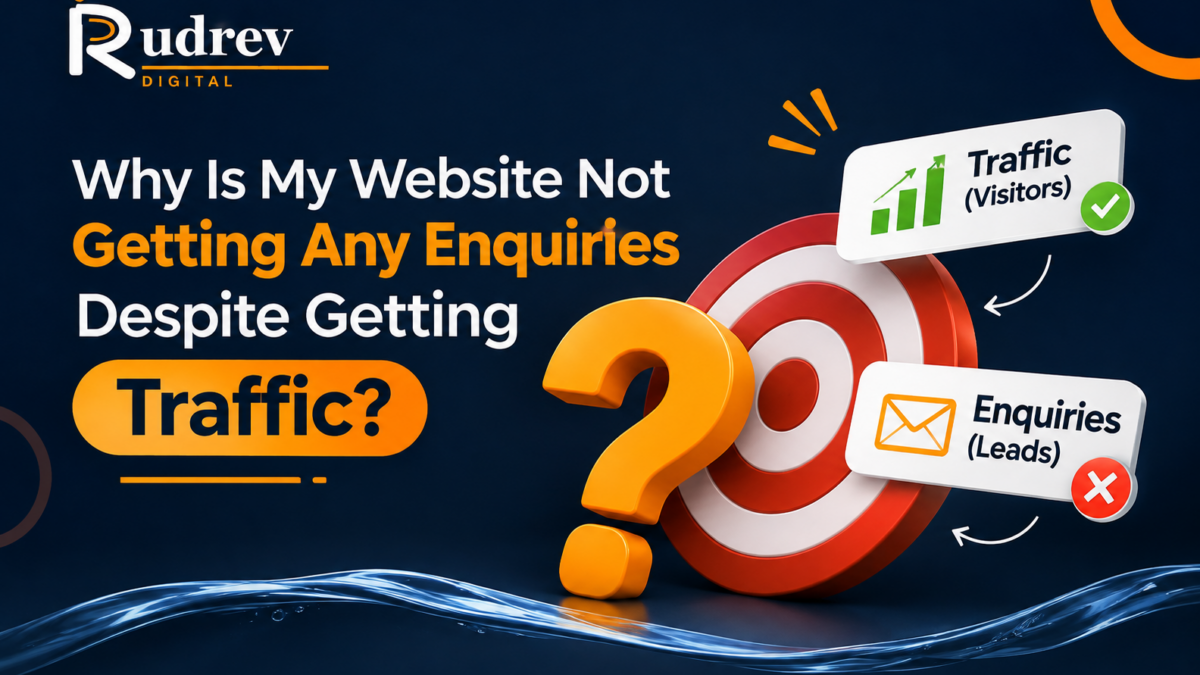
You check your analytics and the numbers look good. Visitors arrive every day and the traffic graph points up. Yet the inbox is quiet, the contact form is empty and the phone isn’t ringing.
If your website is not getting leads even though people are visiting, you are not alone. It is one of the most common problems we see at Rudrev Digital, and it is usually fixable. Traffic is only the first step. Website lead generation depends on whether the right visitors land on the right page, trust what they see and find an easy way to get in touch.
Quick Answer: Why Does a Website Get Traffic but No Enquiries?
A website gets traffic but no enquiries when visitors are the wrong audience, the offer is unclear, there is no strong call to action, forms create friction, the site is slow or untrustworthy, or tracking is broken. Fixing these issues raises your website conversion rate, which is the percentage of visitors who take a desired action such as filling in a form, calling or booking a consultation.
Key Takeaways
- More traffic does not equal more leads. Relevance and intent matter more than volume.
- The nine most common causes are listed below, with a fix for each.
- Check tracking first. You may be getting enquiries you can’t see.
- Change one thing at a time and measure the result.
What Is Website Traffic Conversion and Why Does It Matter?
Website traffic conversion is the process of turning visitors into enquiries, leads or customers. Two sites can receive identical traffic and produce very different results, because conversion depends on relevance, clarity, trust and ease of action.
How do you calculate website conversion rate?
Conversion Rate = (Number of Enquiries ÷ Number of Visitors) × 100. For example, if 2,000 people visit in a month and 20 submit an enquiry, your conversion rate is 1%. What counts as “good” varies by industry, offer and traffic source, so compare against your own past performance before chasing outside benchmarks.
9 Reasons Your Website Is Not Getting Enquiries Despite Traffic
1. Why does the wrong kind of traffic produce no enquiries?
Not every visitor is a potential customer. If your top pages answer informational “what is” or “how to” queries, readers may be learning, not buying.
How to check: Open Google Search Console and review the queries bringing visitors to your key pages. Ask whether those people would realistically hire you.
How to fix it: Build pages around commercial intent such as “[service] in [city]”. Shifting your SEO services strategy toward buyer-intent keywords attracts visitors closer to a decision. If you serve a specific region, local SEO helps you appear to people searching nearby.
2. Is an unclear value proposition costing you enquiries?
Yes. Visitors decide within seconds whether a page is relevant. Vague headlines like “Welcome to our website” or “Excellence in everything” make people leave without knowing what you do.
How to fix it: Your headline should state what you offer, who it’s for and why someone should choose you. Example: “Google Ads management for B2B companies that want qualified enquiries, not just clicks.”
3. Why does a missing call to action reduce leads?
A page without a clear next step leaves visitors to decide on their own, and most won’t. It is a leading cause of a website not getting leads.
- Place one primary call to action above the fold.
- Repeat it after key sections.
- Use action-oriented text like “Get a Free Quote” or “Book a Consultation”, not “Submit”.
- Make buttons visually distinct from the rest of the page.
4. How do contact forms create friction?
Long forms, intrusive mandatory fields and forms that fail on mobile all reduce enquiries.
- Ask only for name, email or phone, and a short message.
- Test the form yourself on desktop and mobile every month.
- Confirm notification emails reach your inbox, not spam.
- Add a click-to-call button and a WhatsApp or chat option if they suit your audience.
5. Does a slow or non-mobile-friendly website hurt enquiries?
Yes. A large share of traffic comes from phones. If pages load slowly, text is tiny or buttons are hard to tap, visitors leave before seeing your offer.
How to fix it: Run key pages through Google PageSpeed Insights and review the Core Web Vitals report in Search Console. Compress images, reduce heavy scripts and use responsive design. If problems run deeper, technical SEO or a website redesign may be the most effective fix, and ongoing website maintenance stops performance slipping over time.
6. Which trust signals does your website need?
People rarely enquire with a business they don’t trust. Add:
- Genuine client testimonials and reviews
- Case studies with real, specific outcomes (see our case studies for an example of how results can be presented)
- Certifications, awards or partner badges you actually hold
- A detailed About page with real team members
- Clear contact details, a physical address where applicable, and visible privacy and refund policies
These also support Google’s E-E-A-T principles: experience, expertise, authoritativeness and trustworthiness.
7. What happens when your content doesn’t match visitor expectations?
If someone clicks an ad or search result promising one thing and lands on a page about another, they leave. This mismatch hurts website traffic conversion and wastes marketing spend.
How to fix it: Match each landing page to the keyword or ad that brings people there. Professional Google Ads management or Meta Ads management should include landing page alignment, not just click optimisation.
8. Why do visitors need a journey, not just a “Contact us” button?
Most visitors aren’t ready to enquire on their first visit. Offer lower-commitment steps such as a free audit, a downloadable checklist, a pricing guide or a short assessment, then follow up. A structured lead generation approach pairs these offers with nurturing, and for longer sales cycles B2B digital marketing strategies are built around exactly this.
9. Could broken tracking be hiding your enquiries?
Sometimes the problem is measurement, not demand. Calls, WhatsApp clicks and form submissions often go untracked.
- Set up conversion tracking in Google Analytics 4 for form submissions, calls and button clicks.
- Use Google Tag Manager to manage events cleanly.
- Ask enquirers “How did you find us?” to cross-check your data.
- Find pages with high exits and zero conversions and fix them first.
Summary Table: Problem, Sign and Fix
| Problem | Common sign | First fix |
| Wrong traffic | Visitors read blogs, never visit service pages | Target commercial-intent keywords |
| Unclear offer | High bounce rate on homepage | Rewrite headline: what, who, why |
| Weak call to action | Visitors scroll but don’t click | One clear button above the fold |
| Form friction | Form views high, submissions low | Shorten the form and test on mobile |
| Slow or poor mobile | Mobile exits much higher than desktop | Compress images, fix Core Web Vitals |
| Low trust | Visitors reach contact page, then leave | Add reviews, case studies, credentials |
| Intent mismatch | Paid clicks with no conversions | Dedicated landing pages per campaign |
| No journey | Only “contact us” offered | Add a free audit or checklist |
| Broken tracking | Zero conversions recorded | Set up GA4 events and test them |
How Do You Diagnose Your Website? A Simple 5-Step Process
- Check traffic quality. Use Search Console and analytics to see which queries and sources send visitors.
- Audit key pages. Review your homepage, service pages and contact page for clarity, calls to action and trust.
- Test the enquiry path. Submit your own form, click your own phone number and confirm everything works.
- Review behaviour data. Use heatmaps and session recordings (Microsoft Clarity is a free option) to see where visitors hesitate or leave.
- Fix, test and measure. Change one thing at a time so you know what improved results.
A professional SEO audit can speed this up by surfacing technical, content and conversion barriers in one structured review.
What Small Changes Can Increase Website Enquiries?
These are illustrative scenarios, not guaranteed outcomes. Results vary by business, industry and market.
- Service business: A local clinic’s contact form sits at the bottom of a long page. Moving a short “Book an Appointment” form and a click-to-call button higher up makes the next step obvious. See our healthcare industry approach.
- B2B manufacturer: A catalogue-style site with no enquiry path can add a “Request a Quote” button on every product page and a short form asking only for requirements and contact details. See our manufacturing page.
- SaaS company: A pricing page with no demo option leaves ready buyers with nowhere to go. A “Book a Demo” call to action and a short walkthrough captures that interest. See how this works for SaaS brands.
Checklist: How to Improve Your Website Conversion Rate
- ☐ Headline clearly states what you do and who it’s for
- ☐ One primary call to action above the fold on key pages
- ☐ Forms are short, tested and delivering emails reliably
- ☐ Pages load quickly and work smoothly on mobile
- ☐ Testimonials, case studies and credentials are visible
- ☐ Landing pages match ad and search intent
- ☐ Conversion tracking is set up and verified
- ☐ You offer a lower-commitment option for early-stage visitors
When Should You Bring in a Specialist?
If you’ve worked through the checklist and your website is still not getting leads, the cause may be a mix of strategy, design and technical issues that are hard to see from the inside. Rudrev Digital helps businesses connect traffic quality, website experience and conversion strategy so marketing effort turns into real conversations.
Explore our full range of digital marketing services, compare our packages, or see our Ahmedabad digital marketing offering if you’re based locally. When you’re ready, contact Rudrev Digital to talk through your goals. No ranking or lead volume can be guaranteed, but a structured, data-led approach gives you a clear way to improve.
Conclusion
When your website is not getting leads despite steady traffic, the problem is rarely a single issue. It’s usually a mix of mismatched intent, unclear messaging, weak calls to action, form friction, slow performance, missing trust signals and poor tracking. Each can be diagnosed and improved.
Start with the checklist, fix the biggest gaps first and measure every change. Over time, a stronger website conversion rate will help you increase website enquiries from the traffic you already have. If you’d like expert help, talk to Rudrev Digital about your website lead generation goals.
Frequently Asked Questions
Why is my website getting traffic but no leads?
Usually because the traffic doesn’t match buyer intent, the offer isn’t clear, calls to action are weak, or the site lacks trust and ease of use. Broken tracking can also hide enquiries that are actually happening.
What is a good website conversion rate?
It depends on your industry, offer and traffic source. Measure your current rate and aim to improve it steadily rather than chasing a universal number.
How can I increase website enquiries quickly?
Start with a clearer headline, one visible call to action, a shorter form, faster page speed and visible testimonials. These changes often have more impact than driving additional traffic.
Does more traffic mean more leads?
Not necessarily. Ten highly relevant visitors can produce more enquiries than a thousand casual ones. Quality and intent matter more than volume.
How do I know if my contact form is working?
Submit a test enquiry from desktop and mobile, check the notification arrives in your inbox and spam folder, and confirm the submission is recorded in your analytics.
Can slow website speed affect lead generation?
Yes. Slow pages frustrate visitors and increase the chance they leave before seeing your offer. Improving speed supports both user experience and website lead generation.
Should I fix my website or invest in more ads?
Fix the conversion problems first. Sending more paid traffic to a site that doesn’t convert simply increases wasted spend.
How long does it take to improve website traffic conversion?
Simple fixes like forms and calls to action can show effects within weeks, while strategic changes such as content and SEO take longer. Timelines vary and no agency can promise specific results.